
EOL transition guide · Published
Replacing a Micron 1300 SSD: the 5300 and 5400 path
The original 1300-to-5300 guidance, with a current path toward 5400 and the capacity, endurance and qualification details to check.
On this page
Original guidance by Keith Peterson, February 2021. Updated by Edge September 11, 2026 for the subsequent 5300-to-5400 transition.
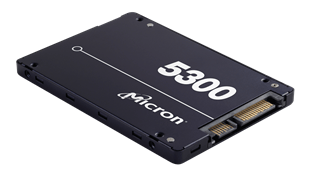
The Micron 1300 was a client SATA SSD. When it reached end of life, Edge’s original guidance described the move to the enterprise Micron 5300. The 5300 has since reached end of life too, so a replacement review now should include the Micron 5400.
The path is 1300 → 5300 → 5400. It describes the product generations; your design still needs a review of the exact proposed drive. The 5300-to-5400 guide provides the next set of configuration cross-references.
Why the original guide considered enterprise SATA
Keith’s original explanation focused on endurance, capacity choices and enterprise data protection. Both the 1300 and 5300 use SATA 6 Gb/s, offer 2.5-inch and M.2 configurations, and use 96-layer TLC NAND. That gives the transition a common interface and familiar mechanical options, while the enterprise family serves different workload requirements.
The shared interface does not make every configuration interchangeable. Check the connector, module dimensions, power requirements, usable capacity, firmware and required security options in the host system.
Endurance and reliability
The original guide’s main point remains useful: the enterprise family offers different write-endurance options. These are the published figures for the examples around the 1TB capacity class:
| Drive | Specified capacity | Published endurance |
|---|---|---|
| Micron 1300 | 1TB | 400 TBW |
| Micron 5300 PRO | 960GB | 2,628 TBW |
| Micron 5300 MAX | 960GB | 8,760 TBW |
Micron lists 5,256 TBW for the 1.92TB 5300 PRO, rather than the 960GB model. These are each drive’s published ratings under its specified test conditions; application workload affects actual endurance.
The manufacturer’s MTTF figures are 1.5 million device hours for the 1300 and 3 million for the 5300. MTTF is a population reliability measure, rather than a promised life for an individual drive. The original 5300 brief also specifies a warranty of up to five years.
Sources: Micron 1300 product brief, revision B, January 2019 and Micron 5300 product brief, August 2019.
Capacity and form factor
The 1300 offered 256GB through 2TB in 2.5-inch form, and up to 1TB in M.2. The 5300 expanded the 2.5-inch range to 240GB through 7.68TB; its M.2 options reached 1.92TB. The 5400 has its own model and capacity combinations, shown in the 5400 product brief.
Use the specified capacity when checking an existing software image or storage requirement. Drives described informally as the same capacity class can have different usable space.
Enterprise data protection and management
The 5300 offered power-loss protection for both data at rest and data in flight, enterprise data-path protection, Flex Capacity, secure firmware, adaptive thermal monitoring and RAIN. Security configurations included TCG Opal and TCG Enterprise options.
The 1300’s product brief describes protection for data at rest, optional TCG Opal encryption and low-power modes for client systems. It also supports Storage Executive, so that management tool is shared rather than an enterprise-only difference.
For a current 5400 proposal, confirm the required features against the exact configuration. A client system’s power behavior and qualification requirements remain part of the decision even when the enterprise drive offers more write endurance.
Plan the replacement
Send us the complete 1300 part number, the system it is used in, and your production timing. Ask about a replacement; we can compare the available SATA options and help work through qualification and supply.